

News
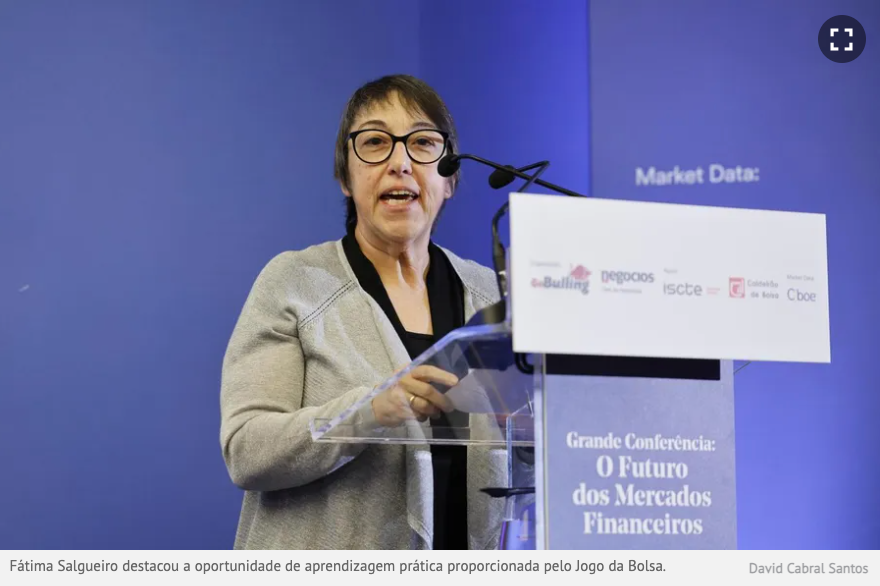
The 15th edition of the conference “The Future of Financial Markets” was hosted by Iscte Business School on 29 October. It was organised by Jornal de Negócios, a leading Portuguese business daily, and Banco Carregosa, as part of Jogo da Bolsa, a stock market simulation game. On 12 November, the newspaper published a special supplement on the conference. It highlights the remarks of the Dean of Iscte Business School, Maria de Fátima Salgueiro, on Jogo da Bolsa as an opportunity for hands-on learning about how markets and financial instruments work.
Fátima Salgueiro described it as the largest initiative in Portugal focused on capital markets. Over four weeks, professionals and students simulate the real-time trading of financial instruments on the GoBulling platform.
Registration closed on 1 November and the competition is now under way. Prizes will be awarded for:
- the best weekly performances;
- the top three in the overall ranking;
- the top three university participants;
- the three highest-ranked Iscte Business School participants, with the winner eligible for an internship in Banco Carregosa’s trading room.
At the opening of the conference, Sofia de Sousa Vale, Vice-Rector of Iscte, described the university as a place for producing knowledge and for critical reflection, on a topic where such reflection is especially needed. She also highlighted the conference’s ability to keep pace, edition after edition, with major shifts in monetary policy and the markets.
Francisco Oliveira Fernandes, CEO of Banco Carregosa, argued that financial literacy is essential for informed decision-making. He also revealed that Iscte students make up more than a quarter of the participants in this year’s game. João Silva Lopes, Secretary of State for the Treasury and Finance, presented measures to broaden companies’ sources of funding and reduce the costs of accessing the market.
Iscte Business School Professor Szabolcs Sebestyén took part in the roundtable on the challenges facing markets in an uncertain world. Drawing on the IMF’s Global Financial Stability Report, he identified three risks: debt issued by companies linked to artificial intelligence, sovereign debt, and cyber incidents. He warned of the growing competition between AI financing and governments’ borrowing needs. He also stressed that the costs of AI come before the productivity gains, which remain uncertain.
Read the supplement (in Portuguese) in Jornal de Negócios.